Science of Wonder · 02
Why We Keep Looking Up
The sky has always asked questions. What changed was what we learned to do with them.
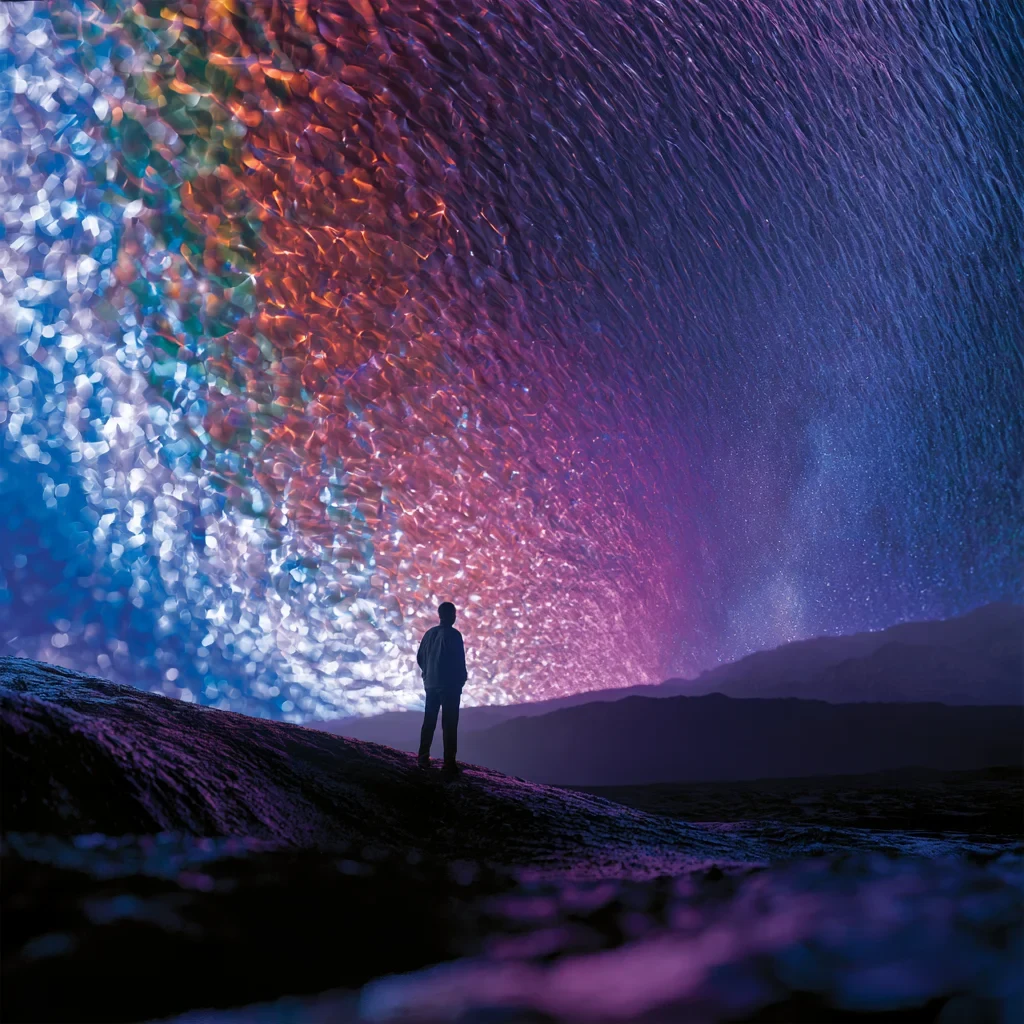
Image: Lance Lang / Midjourney
I have always loved space, partly because of how much of it remains difficult to comprehend. You can learn the distance to a star, understand that the light reaching your eyes began its journey years or centuries ago, and still find that the numbers do very little to diminish the experience of actually looking up. If anything, knowing more tends to make the scale feel even stranger.
Human beings have been confronting that scale for thousands of years. But the sky has never been only a source of beauty or philosophical reflection. Long before astronomy became a formal science, people were observing the Sun, Moon and stars closely enough to recognize patterns, mark seasons, navigate landscapes and organize parts of daily life. Curiosity about the sky repeatedly became something practical.
Before astronomy had a name
The earliest relationship between people and the sky was built through observation. Communities noticed where the Sun rose and set at different times of year, which stars appeared during particular seasons, and how the Moon moved through its cycles. Over time, those observations became systems of knowledge.
Archaeological evidence from Ancestral Pueblo communities, for example, shows astronomical observations reflected in architecture, rock markings and seasonal practices. Solstices and other celestial events could be identified with enough consistency to become meaningful markers in community life. (Source)
What interests me about this is how naturally curiosity and usefulness overlap. Someone first notices that something happens. Then they notice that it happens again. A pattern begins to emerge, and eventually that pattern becomes information people can use.
The sky became a calendar before anyone needed to call it one.
When the sky became a map
Astronomy eventually became essential to another basic human problem: figuring out where we were.
For centuries, sailors crossing open water relied on celestial navigation. Instruments such as the sextant allowed navigators to measure the angle between a celestial body and the horizon. Combined with accurate timekeeping and astronomical tables, those observations helped determine a ship's position when there were no visible landmarks. (Source)
There is something remarkable about that relationship. When surrounded by an ocean with nothing nearby to tell you where you are, you can look toward something unimaginably distant and use it to find your position on Earth.
That pattern appears repeatedly throughout the history of astronomy. We begin by looking outward and somehow end up learning more about where we stand.
When the old explanation stopped working
The planets presented a different problem. Unlike the stars, which appeared relatively fixed in relation to one another, planets seemed to wander across the night sky. At certain points they even appeared to reverse direction.
Explaining those movements became one of astronomy's long-running problems. For centuries, increasingly complicated models were constructed to preserve the idea that Earth sat at the center of the system. Eventually, the observations became easier to explain when the model itself changed.
Copernicus proposed a heliocentric system in which Earth and the other planets orbit the Sun. Galileo's observations provided further evidence that the heavens did not behave as an Earth-centered universe predicted. Johannes Kepler later showed that planetary orbits were elliptical rather than perfect circles, and Isaac Newton developed a theory of gravity capable of explaining the motion of objects both on Earth and in the heavens. (Source)
That progression is one of the things I find most interesting about science. A question about an odd movement in the night sky did not remain a question about an odd movement in the night sky. Following it eventually changed our understanding of motion itself.
The original question did not know where it was going.
Looking back at ourselves
Eventually, our relationship with the sky changed again. We stopped being limited to observing it from the ground.
Apollo 8 became the first crewed mission to orbit the Moon in December 1968. During that mission, astronaut Bill Anders photographed Earth rising above the lunar horizon. The image became known as Earthrise and eventually became one of the most recognizable photographs of the space age. (Source)
I think part of its power comes from the reversal it represents. For almost all of human history, Earth had been the place from which we looked at everything else. Suddenly, Earth itself was the distant object.
From that perspective, the planet looks small, bright and isolated against an enormous amount of darkness. Astronauts have often described a related shift in perspective after seeing Earth from space, commonly referred to as the overview effect. The experience does not produce exactly the same reaction in everyone, but accounts frequently return to similar observations: Earth's apparent fragility, the thinness of its atmosphere and the strange absence of the political borders that dominate so much of life on the ground. (Source)
You can know all of those things before seeing Earth from space. What changes is the frame.
Understanding something intellectually and experiencing its scale are not always the same thing.
Why we still look up
Our curiosity about the sky has produced an extraordinary amount of practical knowledge. Astronomy has contributed to navigation, calendars, physics, communications, satellites and our understanding of the universe itself. But I don't think usefulness completely explains why people continue looking upward.
We also look because there is still something there that we do not understand.
Every generation has inherited a sky filled with unanswered questions. Some of those questions eventually became useful in ways nobody asking them could reasonably have predicted. Others simply expanded our understanding of where we are and what surrounds us.
That distinction matters to me because we live in a time that often asks ideas to justify themselves immediately. What is the application? What is the return? What problem does it solve?
Those are necessary questions, particularly when you are building something. But they are not the only questions worth asking.
Curiosity often comes before utility.
Nobody looking at a strange planetary motion centuries ago could have described every consequence of understanding gravity. The first people carefully recording celestial cycles could not have mapped the technologies that would descend from centuries of astronomical research.
They simply kept looking closely enough for the next question to appear.
Wonder as a direction
When I say Wonder makes more possible, this is part of what I mean.
I don't mean that every curious thought becomes an invention or that every question eventually produces something valuable. Plenty of questions lead nowhere, and discovery is rarely as clean as the stories we tell after the fact.
What wonder does is create movement. It makes us examine something we would otherwise accept. It exposes the boundaries of what we currently understand and gives us a reason to push against them.
Sometimes that produces a better question. Sometimes it produces knowledge. Occasionally it produces an idea or technology that changes far more than anyone expected.
Human beings have been looking up for thousands of years. We have answered questions our ancestors could barely have imagined asking, and in doing so we have discovered even more that we do not know.
Maybe that is why we keep looking.
Not because the sky has refused to give us answers, but because every answer has shown us how much more there is to understand.