Science of Wonder · 03
What Wonder Makes Possible
Curiosity does not always know where it is going. That may be exactly why we should follow it.
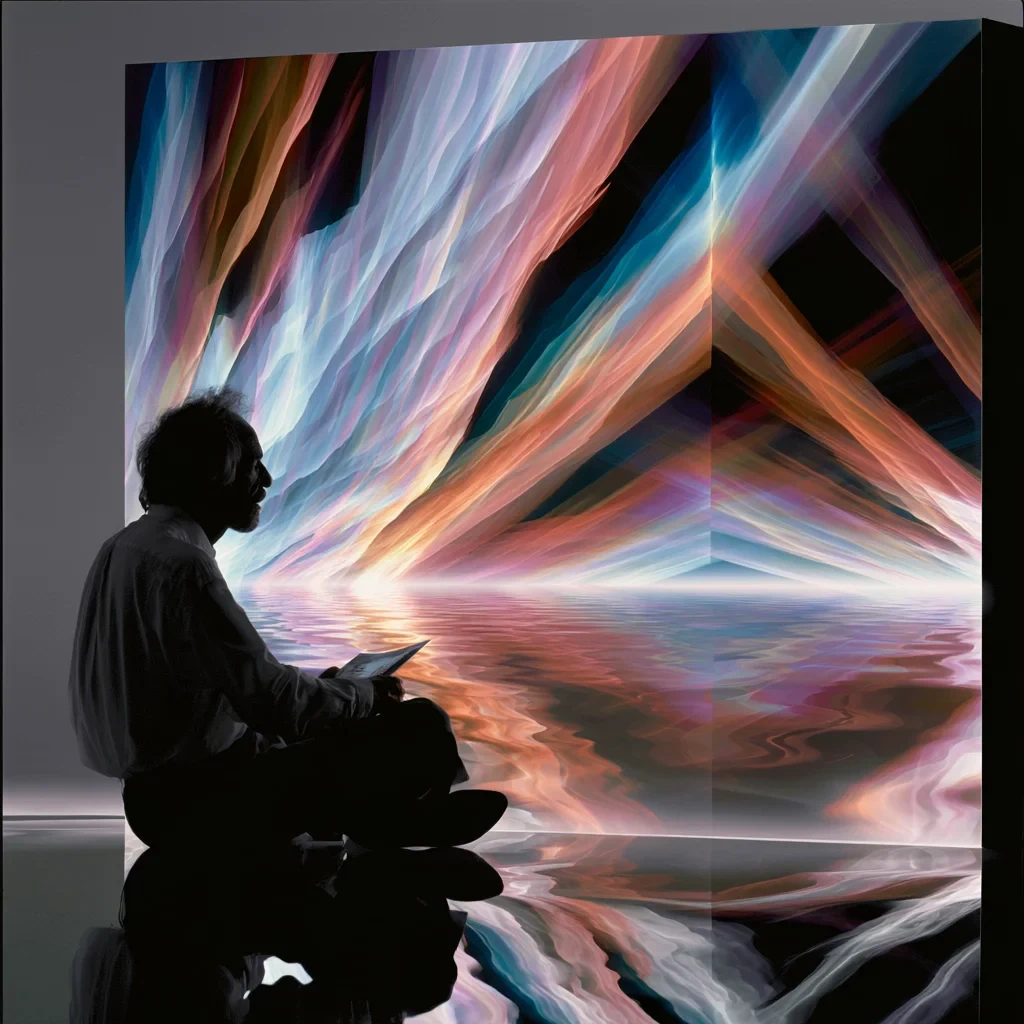
Image: Lance Lang / Midjourney
When I was in my twenties, I came across an idea from Neil deGrasse Tyson that stayed with me. He was talking about the natural curiosity children have about the world, and how easy it is for adults to interfere with it. Tyson has described scientists as people who, in a sense, never lost that childhood impulse to explore. In an earlier PBS interview, when asked what advice he would give a very young aspiring astrophysicist, his answer was essentially that parents sometimes need to get out of the way and let children investigate. (Source)
I understood immediately what he meant.
Watch a child encounter something unfamiliar and there is rarely just one question. What is that? Why does it do that? What happens if I touch it? What happens if I turn it upside down? Why is the sky that color? Where does the Moon go? Why can't I do this? What happens if I do it anyway?
Developmental researchers describe curiosity as a widespread characteristic of childhood that helps direct attention toward gaps in knowledge and motivates information-seeking. Children do not simply absorb the world around them. They actively investigate it. Researchers at UC Berkeley have gone so far as to compare the way children build and revise causal models of the world with aspects of how scientists form and test theories. (Source)
Then we grow up.
That curiosity does not simply disappear, and I do not think parents or schools deserve some blanket accusation for destroying it. There are perfectly good reasons adults tell children not to touch something, climb something, take something apart, or spend an hour following a question when everyone needs to leave the house in five minutes. Safety matters. Structure matters.
But I do think something can happen gradually. We become very practiced at stopping the exploration.
We learn which questions are useful, which ones are on the test, which ones belong in the meeting, which ones make us sound uninformed, and which ones are probably better kept to ourselves. Some research has found that question-asking declines after children enter formal schooling, although that observation alone does not establish that schooling causes the decline. Other work has found that deliberately giving students more practice asking questions can increase measures of curiosity. (Source)
By adulthood, many of us have become extremely good at operating inside what is already known.
I have never been particularly good at leaving it there.
Questions without an obvious destination
I've always been curious about the world around me, particularly the parts of it that I don't completely understand. Space and physics have had a hold on me for a long time. I still keep a copy of Brian Greene's The Elegant Universe. I've admired people like Carl Sagan because they could explain enormous ideas while making you feel that understanding them only gave you more reasons to keep asking questions.
That is something I have always loved about science.
A good question does not promise you a useful answer.
It does not even promise that the question you started with will still be the important question by the time you are finished.
Sometimes people investigate something simply because they want to know.
That kind of curiosity can look inefficient from the outside. It may not have a market, a product requirement, or an obvious application waiting for it. Yet history is full of things that became important because someone followed a problem farther than its immediate usefulness suggested they should.
One of my favorite examples came from a place I have been fascinated with for years: CERN.
CERN exists to study fundamental physics. It was not created to reinvent publishing, commerce, communication, entertainment, or the way billions of people exchange information. Yet by the late 1980s, scientists working with CERN were spread across universities and laboratories around the world, and sharing information between all of those people and incompatible computer systems had become difficult.
Tim Berners-Lee started working on that problem.
In March 1989, he proposed an internet-based hypertext system that could connect information stored across different computers. By the end of 1990, the first web server and browser were operating at CERN. What began as an answer to an information-sharing problem among scientists became the World Wide Web. In 1993, CERN made the software freely available, helping the Web spread far beyond the research community it had originally been designed to serve. (Source)
Nobody began that story by saying, "Let's create the infrastructure that will eventually transform global commerce, media, education, politics, entertainment, and communication."
There was a problem.
There was curiosity about solving it differently.
Someone followed the question.
The opportunity became visible later.
Artificial intelligence began with a question too
AI is another example, although its history is much longer than the recent explosion of generative AI makes it seem.
In 1955, John McCarthy, Marvin Minsky, Nathaniel Rochester, and Claude Shannon proposed a summer research project at Dartmouth around an ambitious conjecture: could aspects of learning and intelligence be described precisely enough for machines to simulate them? The workshop took place in 1956 and helped establish artificial intelligence as a field of research. (Source)
Think about the audacity of the question at the time.
Could a machine learn?
Could it reason?
Could it recognize patterns?
Could it use language?
Could intelligence itself be understood well enough that some portion of it could be reproduced computationally?
Researchers spent decades pulling on different parts of those questions. There were successes, disappointments, periods of enormous optimism, periods of reduced funding, competing approaches, and technologies that worked in laboratories long before ordinary people had any reason to know they existed.
Some of the work that eventually contributed to modern AI did not even begin as an attempt to build the products we use today. Research funded in the late 1970s and 1980s to understand human cognition through computational models helped develop ideas that later became important to neural networks and deep learning. The path between the original research questions and today's systems was anything but direct. (Source)
That is what makes the history interesting.
AI was not one machine someone switched on.
It was generations of people asking variations of an enormous question.
What could a machine learn to do?
Then the question landed on everyone's desk
For most people, artificial intelligence did not feel like part of everyday life in 1956.
That changed dramatically in the years surrounding and following the pandemic. Machine learning was already everywhere, often invisibly, in search engines, recommendation systems, fraud detection, translation, computer vision, speech recognition, and countless other systems. But conversational generative AI made the technology tangible in a different way.
ChatGPT was publicly introduced on November 30, 2022. Suddenly, millions of people could sit down at a computer, type something in ordinary language, and interact with a system that could write, summarize, explain, brainstorm, translate, generate code, and continue a conversation. (Source)
Underneath that experience is something both simpler and stranger than it appears.
Modern autoregressive language models are trained to estimate what token is likely to come next given the context that came before it. Tokens can be words, parts of words, punctuation, or other units of text. At sufficient scale, and combined with modern architectures and additional training techniques, that prediction process can support behaviors that look dramatically more sophisticated than the training objective sounds when reduced to a sentence. (Source)
Something that can be described technically as predicting what comes next became a tool people now use to write software, analyze information, explore ideas, plan businesses, study, create images, conduct research, and build entirely new products.
That's fascinating to me.
Not because AI is magic.
Because of what humans started doing with it once it became accessible.
What AI became for me
My own relationship with AI changed quickly.
At first, I approached it the way I think a lot of people did: as a tool for a particular job. Ask a question. Get an answer. Write something. Summarize something. Help solve a problem.
Useful, but contained.
Then I started pushing on it.
I used it to brainstorm stories and explore ideas that were still half-formed. I used it to think through systems and ask how one thing might connect to another. I used it to challenge assumptions, research subjects I knew very little about, work through technical problems, and accelerate the distance between having an idea and actually being able to see some version of it in front of me.
That last part changed something for me.
I have always been the person who wants the whiteboard.
I like asking the question and seeing where it goes. One idea branches into another. That answer creates three more questions. Something from one field suddenly connects with something from another. Sometimes the result is useful. Sometimes the whole trail goes nowhere.
But there has always been another question waiting at the end of that process:
What do I do with the answer?
Do I learn something interesting, close the tab, and move on?
Do I write the idea down somewhere and find it six months later?
Or can I keep going?
Can I turn the answer into a plan, a visualization, a story, a decision, an experiment, a product, or another question that I did not know enough to ask when I started?
That question became part of the reason I started building Mardyn.
I don't want to build another chat box
There are already plenty of places where you can type a question into a rectangle and receive text back from a model.
Mardyn will have conversations. It will share capabilities with other AI products. Some of those similarities are unavoidable because conversation is an incredibly useful interface.
But another ChatGPT is not what I am interested in building.
I'm much more interested in what happens after the answer.
What happens when a question becomes something you can see?
What happens when the answer changes because you change an assumption?
What happens when the research becomes a decision, the decision becomes a plan, or an idea becomes something another person can pick up and continue?
What happens when someone else begins with your work, changes what is different for them, and discovers something neither of you would have reached independently?
To me, that is a much more interesting direction for AI.
The opportunity is not simply to produce more answers.
It is to give curiosity somewhere to go.
Questions we have not thought to ask yet
I want people to use Mardyn for things I would never think to build a feature for individually.
Someone might wonder whether the cities with the highest reported quality of life also have anything interesting in common with walkability, tree coverage, commute patterns, weather, housing costs, or access to public space. Maybe the relationships are meaningful. Maybe they aren't. The point is that the person should be able to follow the question far enough to find out.
Someone might take decades of astronomical observations and turn them into something visual simply because they want to understand how our picture of the universe has changed.
Someone might explore their family history alongside maps, migration patterns, newspaper archives, climate records, and photographs, not because there is an app called "combine these six things," but because the connection occurred to them.
A student might notice two datasets from completely different fields and ask whether they have ever been examined together.
A writer might start with an obscure historical event and end up building an entire fictional world around the questions it raises.
A founder might have an idea that sounds ridiculous at nine in the morning and have enough understanding by that evening to decide whether it deserves another year of their life.
Some of those explorations will lead nowhere.
I think we need to be comfortable with that.
If we demand that curiosity prove its value before we allow ourselves to follow it, we eliminate many of the paths from which unexpected value can emerge.
Curiosity is not the same as certainty
There is also something I want to be careful about.
Being curious does not make an idea correct.
Questioning conventional wisdom does not automatically make the unconventional answer better. Exploring possibilities does not remove the responsibility to verify facts, understand evidence, or admit when the thing we hoped was true simply isn't.
Carl Sagan famously built much of his public work around that combination: wonder at the universe alongside skepticism about what we claim to know.
I think those belong together.
Curiosity asks us to open the door.
Evidence tells us whether there is actually anything on the other side.
Technology should help us do both.
Becoming curious about our curiosity
The part of childhood curiosity I want to keep is not ignorance.
It's permission.
Permission to ask the question before knowing whether it is sophisticated enough.
Permission to explore something without being able to explain its usefulness yet.
Permission to connect things that do not normally belong together.
Permission to discover that the original question was wrong and follow the better one that appeared along the way.
I think a lot of us lose some of that permission as we get older. We become better at execution, responsibility, risk management, and operating within the systems around us. Those are necessary skills. I've built much of my own career around them.
But I don't think maturity should require surrendering the part of ourselves that asks, What happens if I try this?
That is what Wonder makes more possible means to me.
Not that wonder guarantees opportunity.
Not that every question becomes a company, an invention, or a discovery.
It means that before an opportunity can exist, someone usually has to be willing to notice that there might be something there.
Sometimes that begins with a serious scientific problem.
Sometimes it begins with a child taking something apart.
Sometimes it begins with scientists struggling to share documents across computers at CERN.
Sometimes it begins with a group of researchers asking whether a machine could learn.
And sometimes it is just a person staring at a blank whiteboard with a question they cannot quite let go of.
I am building Mardyn because I want to know what happens when more of us have the tools to follow those questions farther.
I'm especially interested in the ones none of us know to ask yet.