Science of Wonder · 01
The Science of Wonder
What the science of awe can teach us about attention, perspective, and the limits of what we know
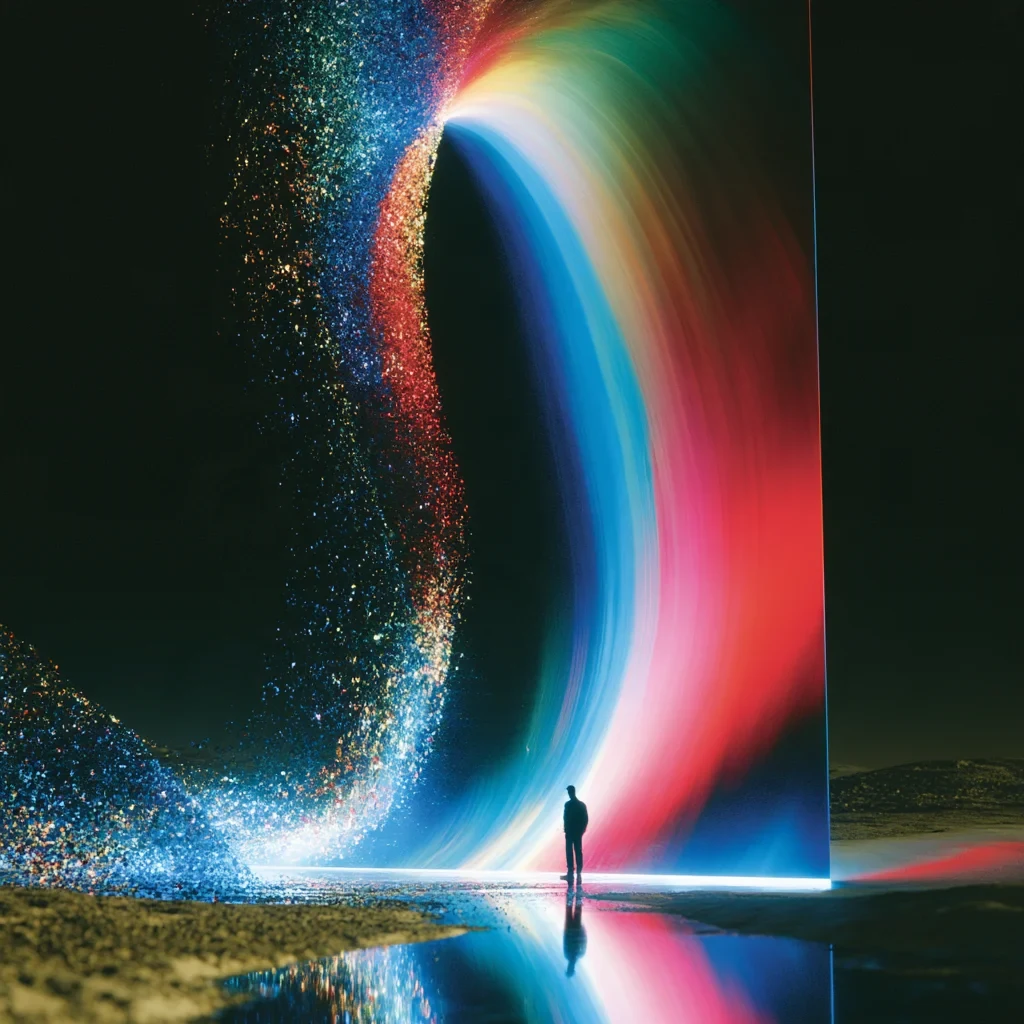
Image: Lance Lang / Midjourney
There are moments when the world seems to become larger without anything around us actually changing. It can happen beneath a night sky, at the edge of an ocean, looking through a telescope, hearing a piece of music, or encountering an idea that suddenly makes what we thought we understood feel incomplete. We can know the facts of what we are seeing and still find ourselves affected by the scale of it.
I have always been drawn to that feeling. Wonder is one of those words we use easily but rarely stop to examine. We associate it with curiosity, imagination, childhood, science, art, and exploration, but those experiences are not all the same thing. Psychology does not have one settled scientific definition of "wonder" that captures everything the word means in ordinary life.
What researchers have studied much more directly is awe.
Awe is not identical to wonder, but it gives us a useful scientific window into part of the experience. It can help us ask what happens when we encounter something large enough, unfamiliar enough, or profound enough that our existing understanding has trouble containing it.
The answers are interesting. They are also less tidy than some popular accounts of awe would suggest.
When our existing frame is not enough
One of the foundations of modern psychological research on awe came from Dacher Keltner and Jonathan Haidt in 2003. They proposed that two appraisals are present in clear experiences of awe: perceived vastness and a need for accommodation.
Vastness does not necessarily mean physical size. A mountain range can feel vast, but so can extraordinary skill, moral courage, a complex idea, or an experience that makes us suddenly aware of a reality much larger than ourselves.
Accommodation is the more interesting part to me. Keltner and Haidt defined it as difficulty fitting an experience into our current mental structures. Something about what we encounter does not comfortably fit the model we already have, so that model may need to change. (Source)
That makes awe more than simply being impressed.
There is a difference between seeing something beautiful and encountering something that makes the way you understood the world a moment ago feel insufficient. Sometimes those experiences are pleasurable. Sometimes they carry uncertainty or even fear. The original model explicitly allowed for different kinds of awe depending on qualities such as beauty, threat, exceptional ability, virtue, and the supernatural. (Source)
More recent research has continued to emphasize that complexity. A 2024 review in Nature Reviews Psychology describes important disagreements in the literature about exactly how awe affects our sense of self and cautions against treating it as one simple, universally positive psychological process. (Source)
That matters because wonder is often packaged as something soft and pleasant.
The science points toward something more demanding.
Sometimes an encounter is powerful precisely because it makes our existing frame harder to maintain.
What happens to our sense of self
One of the better-known ideas in awe research is the small self.
The phrase sounds like it is describing insignificance, but that is not quite the idea. It refers to a relative reduction in how prominent the individual self feels when placed against something perceived as much larger.
In 2015, Paul Piff and colleagues published five studies involving 2,078 participants. Across those studies, they reported that awe was associated with a diminished focus on the individual self and with several forms of prosocial behavior, including generosity, helping, and ethical decision-making under the conditions they tested. The researchers proposed that feeling smaller in relation to something vast could shift attention away from individual concerns and toward a broader social context. (Source)
It is an appealing finding, and it became influential.
It is also where the story becomes more complicated.
In September 2026, researchers published a series of six replication studies examining several prominent experimental claims in the awe literature. When they directly replicated one of the Piff experiments, their awe manipulation successfully produced more reported awe, and participants in the awe condition also reported a greater sense of the small self. However, they did not reproduce the original effect on ethical decision-making. Across the broader replication project, several previously reported downstream effects of awe were not reproduced. (Source)
That does not mean the original work was meaningless, nor does it mean awe has no effect on human behavior. It means the evidence is less simple than saying that experiencing awe automatically makes us more generous or ethical.
The part I find more compelling is the shift in perspective itself.
Something vast can change the scale at which we experience ourselves, even if we should be careful about predicting exactly what behavior will follow from that shift.
The 2024 Nature Reviews Psychology review reaches toward a similar interpretation, proposing that awe may be better understood as encouraging a broader, less egocentric perspective on the self rather than one uniform "small self" effect with predictable consequences. (Source)
That distinction feels important.
Feeling smaller is not necessarily the same as feeling less important.
Sometimes it may simply mean remembering that we are not the entire frame.
Where attention goes
Researchers have also looked at what happens in the brain during experiences designed to elicit awe.
A 2019 fMRI study had participants watch awe-inducing, positive, and neutral videos while either becoming absorbed in the experience or performing a more analytical visual task. In the absorption condition, several regions commonly associated with the brain's default mode network showed less activation while participants watched awe videos than while they watched control videos. Participants also reported feeling a smaller sense of self during the awe condition. (Source)
The researchers interpreted this pattern as being consistent with reduced self-referential processing while participants were immersed in the awe-inducing material.
That is worth wording carefully.
The experiment did not prove that awe "turns off the ego," removes the self, or places the brain into some special transcendent state. Brain networks participate in many processes, and one neuroimaging experiment is not a complete account of an emotion.
What the result offers is a more modest possibility: under those experimental conditions, awe was associated with both subjective reports of a smaller self and lower activity in several regions linked with self-referential processing. (Source)
That feels recognizable to me without needing to exaggerate it.
Most of us have experienced moments when something captures our attention so completely that the running commentary about ourselves becomes quieter. The problem we were replaying, the notification we were waiting for, the next thing on the calendar, all of it briefly becomes less central.
Nothing about our life has disappeared.
Our attention has simply moved somewhere else.
Awe and our awareness of what we do not know
The part of the research that interests me most is not whether awe makes us happier or nicer.
It is what awe might do to our relationship with not knowing.
In 2019, psychologist Jonathon McPhetres published four preregistered studies involving 1,518 participants examining awe as what researchers call an epistemic emotion, an emotion related to knowledge and understanding.
Participants exposed to awe-inducing videos, including virtual reality experiences in one of the studies, reported greater awareness of gaps in their knowledge. That awareness of knowledge gaps was consistently associated with greater interest in science. In one study it was also associated with choosing tickets to a science museum rather than an art museum. (Source)
There is an important qualification here too. The paper's exploratory analyses found that interest in science was sometimes predicted better by positive emotion generally than by awe specifically. So it would be too strong to say that awe alone causes scientific curiosity. (Source)
But the knowledge-gap result is fascinating.
Awe did not simply make participants feel that they knew more.
It made the boundaries of what they didn't know more noticeable.
I think there is something profound in that.
We often imagine knowledge as the accumulation of answers. Learn enough facts, acquire enough expertise, build a sufficiently complete picture, and uncertainty gradually disappears.
In practice, learning often does the opposite.
Understanding something deeply enough allows you to see the edges.
You become capable of recognizing which questions have not been answered yet.
Does awe change how we experience time?
Another influential line of research suggested that it might.
In 2012, researchers Melanie Rudd, Kathleen Vohs, and Jennifer Aaker reported three experiments in which participants induced to experience awe felt that they had more time available or were less impatient. The experiments also reported differences in outcomes such as willingness to volunteer time, preference for experiences over material goods, and momentary life satisfaction. The authors proposed that awe altered participants' subjective experience of time by drawing them more fully into the present moment. (Source)
It is an elegant idea, but it is not something I would describe today as an established effect of awe.
The 2026 replication project directly repeated one of those experiments with a larger sample and did not reproduce the reported differences in perceived time availability, preference for experiential goods, or momentary life satisfaction. There is an important complication, however: in that particular replication, the awe story itself did not produce a statistically significant increase in reported awe compared with the control story. That makes the failed downstream results difficult to interpret cleanly. (Source)
Across the replication project as a whole, the researchers found that several common awe-induction methods successfully increased reported awe, but many of the downstream behavioral and psychological effects they tested did not reproduce. They suggest that the intensity of an awe experience, the way it is induced, and differences between brief laboratory experiences and more substantial real-world experiences may deserve greater attention in future work. (Source)
I actually like that this research is unsettled.
There is something appropriate about studying an emotion associated with the limits of our understanding and discovering that our understanding of the emotion itself still has limits.
Wonder does not need a business case
There is a habit in technology, and probably in modern culture more broadly, of discovering something interesting about human experience and immediately turning it into a tool.
If awe changes attention, perhaps we can use it to improve productivity.
If it increases curiosity, perhaps we can use it to increase engagement.
If it influences perspective, perhaps we can design an experience that reliably produces the outcome we want.
I think there is a danger in approaching wonder that way.
Wonder does not need to justify itself by making us more productive.
A dark night sky is not valuable because it might help someone complete more work tomorrow. Looking through a telescope does not need to result in an invention. An idea can matter because it changes how we understand something, even if there is no immediate economic result waiting on the other side.
The science itself gives us good reason to resist easy optimization stories. There is meaningful evidence that awe relates to our experience of scale, self, attention, and the limits of our knowledge. There is also disagreement about mechanisms, variation across people and cultures, and growing evidence that some widely discussed downstream effects are less robust than earlier studies suggested. (Source)
That does not make wonder less valuable.
If anything, I think it makes it more interesting.
We do not need to reduce an experience to a guaranteed outcome before deciding that it deserves our attention.
Why this matters to me
Mardyn's motto is Wonder makes more possible.
For me, that has never meant that wonder magically produces innovation or that every question turns into something important.
Most questions probably don't.
What wonder does is create the possibility of movement.
You encounter something that does not fit.
You notice a gap.
You realize the explanation you have might not be the only explanation available.
Sometimes the result is simply that you appreciate something more deeply. Sometimes you ask another question. Sometimes that question leads to knowledge, and occasionally the consequences of that knowledge travel much farther than anyone could have predicted when the question was first asked.
That is why the idea of accommodation in the psychology of awe resonates with me so strongly.
There is a particular kind of possibility that appears when our current model stops being enough.
We can defend the model.
Or we can become curious about what lies beyond it.
Science itself depends on that distinction. A result becomes a claim. Someone else tests it. Sometimes it holds. Sometimes it becomes more complicated. Sometimes the question survives while the original explanation does not.
Wonder works in a similar space.
It begins with the recognition that there is more here than we currently understand.
I don't think the science of awe tells us that wonder will make us smarter, kinder, more creative, or more successful. The evidence is too nuanced for claims like that.
What it does suggest is something I find much more meaningful.
Human beings are capable of encountering something that exceeds the frame we brought with us. In those moments, our attention can shift, our place in the picture can feel different, and the boundary between what we know and what we do not know can become easier to see.
That boundary is not a failure of understanding.
It is an invitation to continue.
And somewhere beyond it is the possibility of discovering something we did not know enough to look for before.